Weak regrowth failing in wind
Long-overdue regrowth is attached at the wound edge rather than sound wood, and heavy limbs can tear out under load.
Pollarding
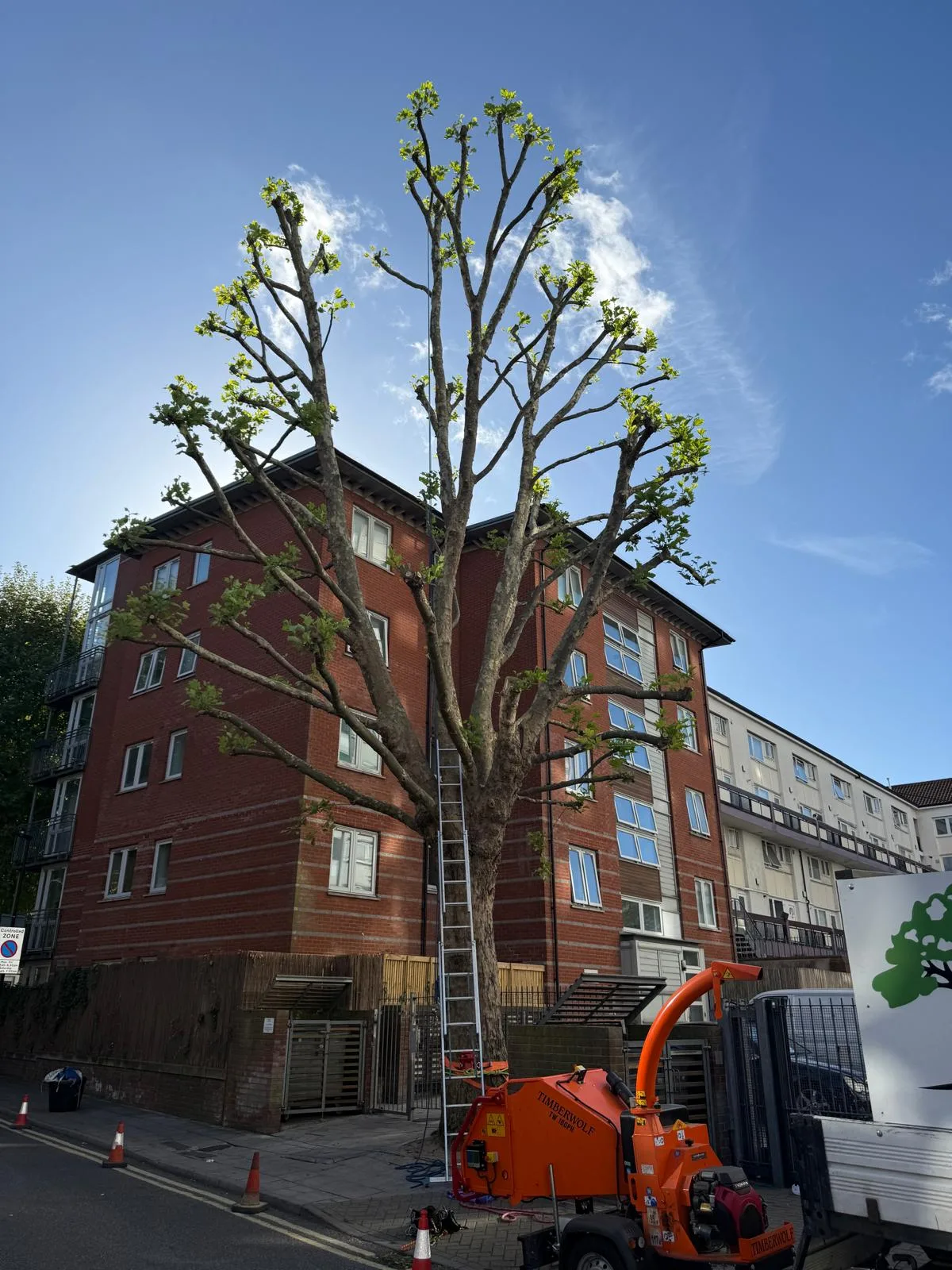
Pollarding cuts a tree's main stems back to a permanent framework so it regrows on a managed cycle instead of outgrowing the space it is in. Done at the right points, on the right species, at the right time of year, it keeps a large tree in a small garden for decades rather than forcing you into a removal.
12 years in the canopy, 59+ five-star Google reviews, £10m employers' and £5m public liability cover.
12 yrs
Hands-on pruning and canopy management across the borders
£15m
Total insurance cover, £10m employers', £5m public and products
NPTC
City & Guilds certificates in climbing, aerial rescue and aerial cutting
7 days
Typical wait for a free site visit, with the written quote the same day
The service
Pollarding is a management system rather than a one-off tidy-up. The upper branches of a tree are cut back hard to a chosen height, and the tree responds by throwing out a dense flush of new shoots from those cut points. Over the years the cut points thicken into knuckles, known as pollard heads, and the regrowth is taken back to the same heads on a repeating cycle, commonly every two to five years depending on species and how much size you want to hold back.
It is the right answer where a vigorous tree is simply too big for where it stands: a willow or poplar overshadowing a small garden, limes along a boundary casting a whole rear garden into shade, a row of street-side trees where the crown cannot be allowed to grow into cables or a roofline. It is also the traditional way of managing willow, lime, London plane, ash, hornbeam and mulberry, all of which tolerate the treatment well and have been managed this way in Surrey, Kent and Sussex for generations.
It is not a treatment to apply casually. Pollarding a species that does not tolerate it, or starting a pollard on a tree far too old and large to respond, is closer to topping than to arboriculture and can leave a declining tree full of weak regrowth. Jack looks at the species, age, condition and the wound size involved before recommending it, and will say plainly when a crown reduction, a lateral reduction or a removal is the better outcome. The work carries £10m employers' liability and £5m public and products liability, and is carried out by an NPTC and City & Guilds certified crew.
Homeowners, landlords, estates and commercial sites with fast-growing trees that need permanent size control in a confined space.
Where a tree is outgrowing its position, casting heavy shade, nearing cables or a building, or where an existing pollard cycle is overdue.
Cutting back to sound framework or existing pollard heads, all arisings chipped and cleared, and the site raked and swept.
TPO applications and conservation-area notices submitted to the council on your behalf before any cutting takes place.
What happens if it's left
An overdue pollard is a common sight around Oxted, Westerham and Edenbridge: a tree last cut eight or ten years ago, now carrying long, heavy regrowth on unions that were only ever meant to hold two or three seasons of growth. Those shoots are attached at the outer edge of an old wound, not deep in sound wood, so as they lengthen and thicken the attachment becomes the weak point. High winds find it before you do.
The shade problem compounds too. A vigorous willow, poplar or lime left unmanaged puts on serious height and spread each season, and by the time the neighbours are complaining about light or the gutters are filling every autumn, you are paying for a much larger job with more rigging and more waste than if the cycle had been kept.
The mistakes we are called out to correct are consistent: trees topped flat at a random height with no framework, leaving huge open wounds that never seal; species pollarded that do not tolerate it, such as most conifers, which simply die back from the cut; pollarding started on an old, over-mature tree that lacks the vigour to respond; and cuts made in the wrong season, so the tree loses its stored reserves at exactly the wrong point in the year.
Long-overdue regrowth is attached at the wound edge rather than sound wood, and heavy limbs can tear out under load.
Cutting into large-diameter old wood creates wounds the tree cannot compartmentalise, opening a route for decay into the stem.
Most conifers and many ornamentals do not regenerate from hard cuts and are left disfigured or dying by an inappropriate pollard.
Every year a cycle is missed adds height, weight, rigging time and waste volume to the eventual job.
Pollarding a protected tree without consent is prosecutable, and councils treat hard pruning of TPO trees seriously.
Hard pruning between March and August risks disturbing an active nest, which is an offence, so the canopy is checked first.
How we do it
01
Jack visits, usually within 7 days, assesses species, age, vigour and existing pollard heads, and checks access for rigging.
02
An honest answer on whether pollarding suits the tree, the sensible height and cycle, and a written itemised price the same day.
03
TPO or conservation-area consent applied for on your behalf, plus a nesting-bird check if it falls in the season.
04
Stems taken back to the agreed framework or existing heads, sections rigged down safely clear of buildings, fences and planting.
05
Arisings chipped, site raked and swept, and the next cycle date agreed with you before we leave.
What you get
The tree is held at a height that suits the garden, the boundary and the building, year after year.
Pollarding is frequently the alternative to removal where a tree has simply outgrown its position.
Heavy shade over lawns, patios and windows is lifted, and gutters stop filling every autumn.
A set cycle of two to five years makes budgeting simple and keeps each visit smaller and cheaper.
£10m employers' and £5m public and products liability cover, held by the crew doing the cutting.
Chipping and clearance are part of the price, not an extra added once the brash is on your lawn.
Pollarding is a long-term commitment to a tree, so the detail matters: which species tolerate it, where the cuts go, how often you return, and when in the year the work is done.
Willow, poplar, lime, London plane, ash, hornbeam, oak, sweet chestnut, mulberry and eucalyptus all respond well to pollarding and are the species we most often manage this way across the borders. They regenerate strongly from dormant buds beneath the bark, so cut points reliably produce new shoots and the tree keeps its vigour through repeated cycles.
Most conifers, including leylandii, pine, spruce and cedar, do not regenerate from old wood and should never be pollarded, cut back beyond green growth and the branch simply dies. Birch, cherry and many ornamental species also react poorly to hard cuts, bleeding heavily or failing to callus. Where a client asks for pollarding on one of those species, we say so and offer a crown or lateral reduction instead.
A new pollard is best started on a young or semi-mature tree while stems are still small enough that the wounds seal quickly, ideally where cut diameters stay modest rather than cutting through large old limbs. The initial cut sets the permanent height, so we agree that with you on site with the building line, boundary and sightlines in mind, because once the heads form, that height is effectively fixed.
Maintaining an existing pollard is a different job: regrowth is cut back to just above the old heads, never into them, so the knuckle stays intact and continues to produce shoots. Cutting into or through the head removes the tissue the tree relies on to regenerate and can kill that point permanently. Where a pollard has been left far too long, we sometimes stage the work over two visits to avoid removing the entire crown from an overloaded tree in one go.
A typical maintenance cycle runs from two to five years. Vigorous species such as willow and poplar in good soil may need cutting every two to three years to stay in proportion, while limes, planes and hornbeams in tighter positions often hold for four or five. The right interval balances two things: leaving it long enough that the work is worth doing, and returning often enough that regrowth is still light and safely attached.
We record the height and date of every pollard we cut so the next visit reproduces the same framework rather than creeping upward each cycle, which is what causes an old pollard to gradually get taller and heavier than intended over decades.
Late winter into very early spring is generally the best window: the tree is dormant, its reserves are stored in the roots and stem, and the flush of regrowth arrives with the growing season. It is also when branch structure is fully visible with no leaf cover, which makes rigging safer and quicker in tight gardens.
Between March and August the canopy is checked for active nests before any cutting starts, as disturbing nesting birds is an offence under UK law and pollarding removes a great deal of habitat at once. Bats also roost in cavities in older pollards, and where features suggest that possibility we adjust the approach rather than cutting blind.
Trees with a Tree Preservation Order, and any tree within a conservation area, need written council consent before pollarding. Because pollarding is a significant intervention, councils scrutinise these applications closely, so the case has to be made properly. We submit applications across Tandridge, Sevenoaks, Reigate and Banstead, Wealden and the surrounding authorities on your behalf.
Where the tree sits on or near a boundary, we talk through access, overhanging limbs and neighbour agreement before booking the work in. Getting that settled at quote stage avoids the far more awkward conversation of stopping mid-job because access over the other side was never agreed.
Questions
Related work
A crown that has outgrown its plot does not need the top taken off, it needs its branch length reduced back to sound growth points, in proportion, so the tree keeps its natural shape and stays healthy while it does the job of clearing a roofline, a boundary or a view.
When a tree is fine everywhere except one side, pressing on a wall, tangled in an overhead line, or crowding a boundary fence, a full crown reduction is more than the problem needs.
A tree that has outgrown its garden, died back, or started leaning over a roof does not get cheaper or safer to deal with.
We cover Oxted, Westerham, Edenbridge, Sevenoaks, Biggin Hill, Bromley, Tunbridge Wells, Redhill and the surrounding villages, see the towns our tree surgeons cover across Surrey and Kent, browse all tree surgery services, read about Jack and the crew, or go straight to the free tree surgery quote form.
Free quote
Send the form or call and we will book a free site visit, usually within 7 days. You get an honest answer on whether pollarding suits your tree, the right height and cycle for it, and an itemised written quote the same day as the visit, with no obligation.
Call 07375 701290Five Pebble Hill Cottages, Westerham Road, RH8 0EA · Mon–Sat 8am–9pm · Sunday closed
We use essential cookies to run this site, plus optional ones for maps and chat. Cookie policy